Hanmi Records Highest Number of AACR Presentations Among Korean Biopharmas
Hanmi Records Highest Number of AACR Presentations Among Korean Biopharmas
Hanmi to unveil 9 preclinical studies across 8 new drug candidates at AACR, starting April 17
Record-high number of presentations for 4 consecutive years: 7 in 2023, 10 in 2024, 11 in 2025, and 9 in 2026
Securing technological competitiveness in emerging modalities, including next-gen mRNA and bispecific ADCs
(April 6, 2026) Hanmi will showcase a broad range of innovative oncology pipeline assets backed by its extensive expertise across next-generation modalities and a strong foundation in evidence-based R&D.
Hanmi Pharmaceutical is set to reinforce momentum in R&D―its key growth engine―by presenting the highest number of research studies among Korean pharmaceutical and biotechnology companies for the fourth consecutive year at the American Association for Cancer Research (AACR), one of the world’s most prestigious oncology conferences.
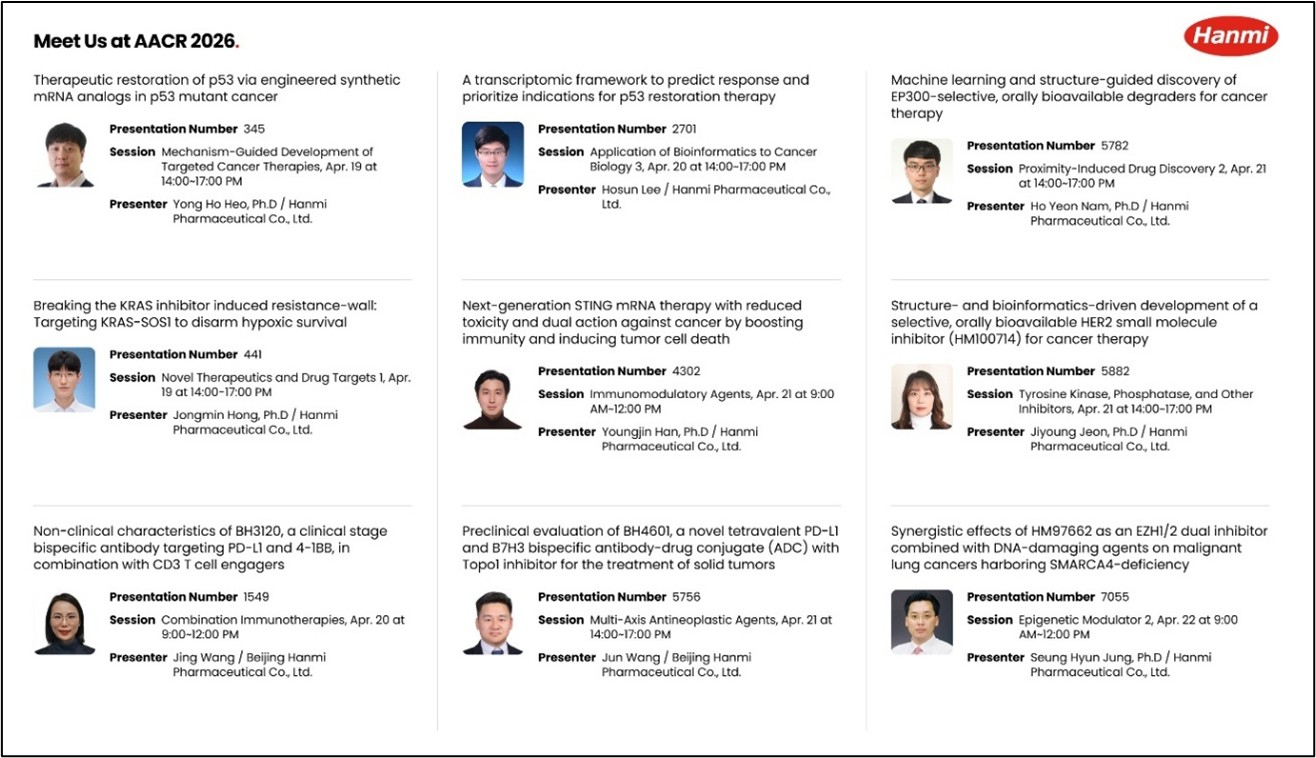
Hanmi will participate in the American Association for Cancer Research Annual Meeting 2026 (AACR 2026), held in San Diego, USA, from April 17 to 22 (local time), and unveil 9 preclinical research posters―the highest number among Korean pharmaceutical and biotechnology companies.
At AACR 2026, Hanmi will present poster data on a total of 8 new drug candidates: ▲EZH1/2 dual inhibitor (HM97662) ▲selective HER2 inhibitor (HM100714) ▲SOS1-KRAS interaction inhibitor (HM101207) ▲ Selective EP300 degrader ▲STING mRNA anticancer candidate ▲two studies on the p53 mRNA anticancer candidate, as well as two assets being proactively developed by Beijing Hanmi Pharmaceutical ▲4-1BBXPD-L1 bispecific antibody (BH3120) and ▲B7H3XPD-L1 bispecific antibody-drug conjugate (ADC) (BH4601).
A large group of researchers from Hanmi’s R&D Center is expected to attend the meeting to present and explain the posters while introducing the company’s innovative programs, which is expected to facilitate meaningful collaboration opportunities with leading global pharmaceutical companies.
◆ Expanding precision targeted oncology technologies against key cancer driver alterations
Hanmi will present findings demonstrating synergistic effects of combining its EZH1/2 dual inhibitor (HM97662) with a DNA damaging agent in a SMARCA4-deficient malignant lung cancer model.
HM97662 is being developed as a next-generation targeted anticancer therapy, featuring a “dual inhibition mechanism” that simultaneously inhibits EZH1 and EZH2 proteins―offering superior antitumor efficacy and the potential to overcome resistance compared with EZH2-selective inhibitors.
The company will also unveil research on its oral targeted therapy candidate, the selective HER2 inhibitor (HM100714), which is under development to treat HER2-mutant cancers. The study presents how the company derived target indications using advanced analytics, including artificial intelligence (AI)-based machine learning and bioinformatics.
HER2 mutations occur across multiple cancer types, including breast and lung cancer, and are known to drive tumor growth and metastasis. In particular, such HER2 mutations are also associated with brain metastases and leptomeningeal metastases―key factors that worsen prognosis and reduce survival.
Hanmi will present research showing that its SOS1-KRAS interaction inhibitor (HM101207) regulates gene expression involved in hypoxia-related survival mechanisms, thereby overcoming resistance in KRAS-dependent cancers. HM101207 is a novel inhibitor designed to block the binding between SOS1 and KRAS―key players in the signaling cascade―to suppress activation of KRAS, one of the most common oncogenic driver mutations.
HM101207 is well positioned as a differentiated combination partner in global oncology. By potentially overcoming limitations associated with current targeted approaches, including KRAS G12C inhibitors, HM101207 offers broad strategic potential in combination regimens for KRAS-driven tumors.
The selective EP300 degrader, first unveiled by Hanmi in October last year, is being developed as an oral targeted therapy leveraging Hanmi’s emerging modality platform, Targeted Protein Degradation (TPD).
At AACR 2026, Hanmi will present research showing that it has identified an optimized selective EP300 degrader with strong anticancer efficacy without adverse effects, using advanced technologies including molecular dynamics simulations, a bioinformatics framework, and AI-driven machine learning.
◆ Accelerating oncology innovation through next-generation mRNA platform modalities
Hanmi will also present research achievements on immuno-oncology candidates based on its “mRNA platform,” an emerging next-generation modality.
The STING mRNA anticancer candidate is designed to induce a robust antitumor immune response by directly expressing an activated STING (Stimulator of IFN Genes) protein. At AACR 2026, Hanmi will introduce research results that not only elucidate the immune activation mechanism but also demonstrate a “dual mechanism” that induces direct tumor cell death, thereby confirming effective antitumor efficacy.
Another mRNA platform-based candidate, the p53 mRNA anticancer therapy, is designed to induce apoptosis in cancer cells by restoring normal intracellular expression of the tumor suppressor protein p53. At AACR 2026, Hanmi will present research showing it developed an analog with enhanced cancer cell death mechanisms compared with wild-type p53, demonstrated strong antitumor activity, and validated mechanisms that may overcome resistance to anticancer chemotherapy.
In addition, Hanmi will present research demonstrating a transcriptome-based predictive framework that uses large-scale datasets and machine learning to estimate responsiveness to p53 restoration therapy, systematically prioritize therapeutically relevant cancer types, and provide scientific rationale for combination strategies.
◆ Beijing Hanmi R&D Center to debut bispecific ADC project
The R&D Center of Beijing Hanmi Pharmaceutical, Hanmi Group’s China subsidiary, will present new research findings on BH3120, an immuno-oncology candidate developed using Hanmi’s proprietary bispecific antibody platform, “Pentambody.” A global Phase 1 clinical trial is currently underway in South Korea and the United States to evaluate the safety and tolerability of BH3120. In parallel with the clinical program, Beijing Hanmi’s R&D Center is conducting a range of preclinical studies to more deeply elucidate BH3120’s in vivo mechanism of action.
Across multiple preclinical studies, BH3120 demonstrated not only robust antitumor efficacy but also a clear decoupling phenomenon of immune activation between the tumor microenvironment (TME) and normal tissues, supporting its potential for effective and safer anticancer therapy. At AACR 2026, Beijing Hanmi will present findings from combination studies of BH3120 with a CD3 T cell engager―an emerging next-generation oncology approach―showing that the two mechanisms act complementarily to amplify antitumor effects, along with the underlying immune mechanism of action.
Beijing Hanmi’s R&D Center will also unveil, for the first time, the mechanism of action and pharmacological activity of its new oncology project, BH4601, generating strong interest. BH4601 is a next-generation oncology project based on a bispecific antibody-drug conjugate (ADC) that simultaneously targets B7H3 and PD-L1, and is expected to present a differentiated mechanism and the potential to overcome limitations of conventional ADC therapies.
“Hanmi Pharmaceutical’s oncology pipeline―the core axis of our new drug development―continues to expand its innovation across a wide range of modalities, including Targeted Protein Degradation (TPD), messenger ribonucleic acid (mRNA), cell and gene therapies (CGT), antibody-drug conjugates (ADCs), and single-domain antibodies (sdAbs),” said Dr. In Young Choi, Executive Vice President and Head of the R&D Center at Hanmi Pharmaceutical. “Grounded in global technological capabilities and state-of-the-art R&D infrastructure, we will integrate new technologies such as artificial intelligence (AI), bioinformatics (BI), and omics across the entire research continuum to lead the next paradigm in new drug development,” he added.