“Korea’s Homegrown GLP 1 obesity therapy with Favorable Efficacy and Safety Nears Filing” ― Hanmi Targets Approval Submission This Year
“Korea’s Homegrown GLP-1 obesity therapy with Favorable Efficacy and Safety Nears Filing” ― Hanmi Targets Approval Submission This Year
(Efpeglenatide, First GLP-1 Based Obesity Drug Developed in Korea)
▶ First new drug from the H.O.P project (efpeglenatide) reports interim topline Phase 3 results at Week 40
▶ Fewer adverse events than competing therapies and optimized, appropriate weight reduction…dosing to continue through Week 64
▶ Approximately 50% of participants achieved ≥10% weight loss… some achieved up to 30% relative weight reduction
▶ 20% of participants achieved ≥15% weight loss… particularly strong efficacy observed in women with BMI ≤30
▶ Largest Korean patient dataset among single GLP-1 obesity trials… domestic launch planned for 2H next year
(October 27, 2025) Hanmi Pharmaceutical, which is developing more than five next-generation obesity drug candidates, announced the release of robust weight reduction efficacy and a favorable safety profile for efpeglenatide, the first launch candidate from its flagship R&D initiative, the H.O.P project. Backed by strong efficacy and well-established safety, efpeglenatide is drawing expectations as Korea’s potential “homegrown obesity drug”.
Among the 448 Korean participants enrolled in the study, some achieved weight reduction of up to 30% by Week 40, confirming strong efficacy. In addition, compared with existing competing therapies, efpeglenatide demonstrated a lower incidence of adverse events such as vomiting and nausea. These results suggest the drug could make a meaningful contribution to the broader adoption of a “healthy weight loss” culture, which is increasingly emphasized across society.
Na-young Kim, Executive Vice President and Head of New Product Development Division at Hanmi who led the clinical program, said, “efpeglenatide, which our late founder and Chairman Lim Sung-ki dedicated tremendous effort to advancing, has taken a significant step closer to commercialization as a ‘homegrown obesity drug’ by demonstrating effective and safe clinical outcomes in Korean patients.” She added, “As both Hanmi’s legacy and the starting point of future innovation, efpeglenatide is poised to evolve into a broadly expandable therapy across metabolic diseases, from obesity to diabetes.”
According to Hanmi, the company disclosed interim topline Phase 3 results at Week 40 for efpeglenatide, an obesity treatment developed in-house using proprietary Korean pharmaceutical technology, through a public announcement on the 27th.
Although the trial is designed to continue dosing and observation through Week 64, Hanmi released the Week 40 interim topline data in consideration of its plan to file for regulatory approval within the year. Further improvements in efficacy metrics are expected with continued dosing beyond the interim analysis.
A Hanmi official commented, “While obesity drug developers typically disclose results after 60 weeks or more of treatment, our decision to release Week 40 interim topline results reflects strong confidence in efpeglenatide’s competitive efficacy, safety, and market potential,” adding, “We will proceed without delay toward our goal of filing for approval within the year and are committed to company-wide efforts to enable a domestic launch in the second half of next year.”
The study was conducted at multiple university hospitals in Korea and enrolled 448 adults with obesity without diabetes. It was designed as a randomized, double-blind, placebo-controlled, parallel-group trial, with the objective of evaluating the superiority of efpeglenatide versus placebo in terms of percent change in body weight and the proportion of participants achieving at least 5% weight reduction.
At Week 40, 79.42% of participants in the efpeglenatide group achieved ≥5% weight loss (placebo: 14.49%), 49.46% achieved ≥10% weight loss (placebo: 6.52%), and 19.86% achieved ≥15% weight loss (placebo: 2.90%). The mean percent change in body weight from baseline in the efpeglenatide group was -9.75%, compared with -0.95% in the placebo group.
Notably, the trial results demonstrated superior efficacy in women with BMI ≤30, rather than in individuals with severe obesity. According to subgroup analyses, female participants with BMI <30 kg/㎡ achieved a mean weight reduction of -12.20%, the highest weight loss observed among all analyzed subgroups.
Another major achievement of the study was confirmation of efpeglenatide’s favorable safety and tolerability profile, in addition to its robust efficacy.
Currently marketed GLP-1 based obesity treatments are associated with relatively high rates of gastrointestinal adverse events such as vomiting, nausea, and diarrhea. In contrast, efpeglenatide demonstrated a substantially lower incidence of these adverse events―by double-digit percentage points compared with previously reported rates―suggesting improved accessibility and tolerability for obesity treatment.
Efpeglenatide’s cardiovascular and renal protective effects are also considered key differentiating strengths versus other GLP-1 products.
According to studies published in leading medical journals including The New England Journal of Medicine (NEJM) and Circulation, efpeglenatide has already demonstrated drug innovation by significantly reducing the risk of major cardiovascular and renal events in a large-scale global cardiovascular outcomes trial (CVOT) involving approximately 4,000 patients.
In addition, efpeglenatide will be manufactured in-house at Hanmi’s BioPlant located in Pyeongtaek, a facility equipped with state-of-the-art, global-standard production capabilities.
This is expected to provide superior price competitiveness versus imported products, while also mitigating chronic supply shortages and frequent stock-out issues commonly associated with overseas therapies.
Alongside the launch of efpeglenatide, Hanmi is actively pursuing expansion into the diabetes indication and the development of Korea’s first digital convergence pharmaceutical by integrating digital therapeutics. Given that lifestyle management and dosing safety are critical considerations in obesity treatment, the digital convergence therapy is designed to provide personalized obesity management solutions―such as dietary and exercise guidance―tailored to individual patient goals.
Jae-hyun Park, CEO of Hanmi Pharmaceutical, said, “efpeglenatide, scheduled for launch next year, will represent another major milestone in Hanmi Pharmaceutical’s continued growth,” adding, “As we also anticipate visible progress from other H.O.P project assets to be introduced sequentially following efpeglenatide, we will further concentrate our capabilities on the successful launch of this first and most critical program.”
[Reference]
■ About H.O.P (Hanmi Obesity Pipeline)
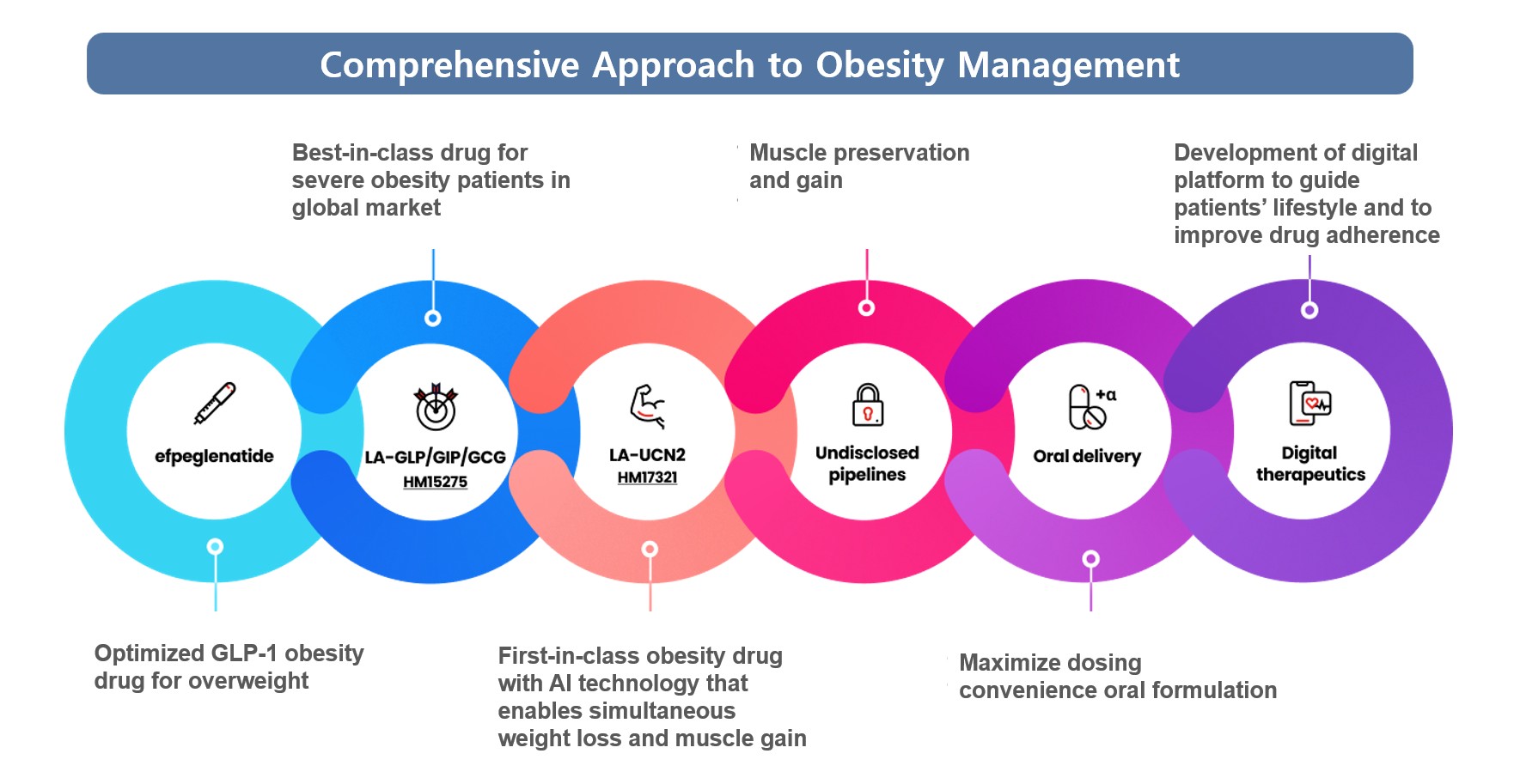
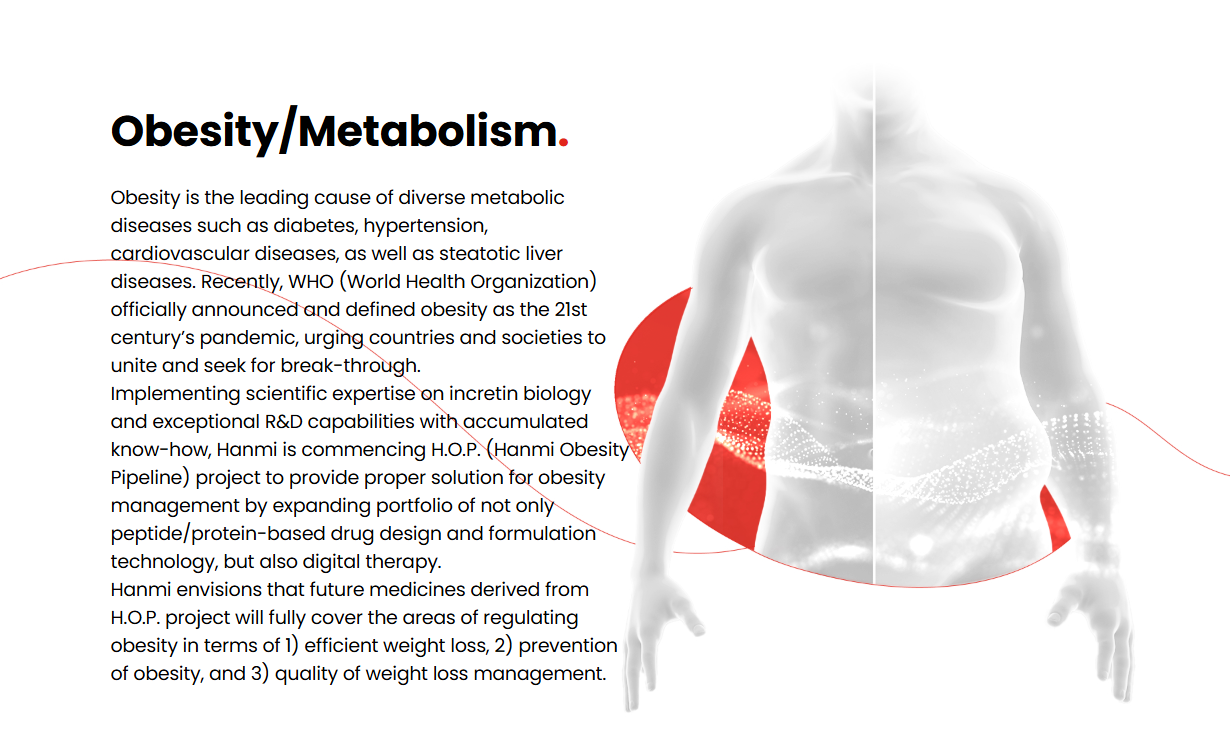
Through its obesity innovation drug development initiative, H.O.P (Hanmi Obesity Pipeline), Hanmi Pharmaceutical is building a comprehensive, lifecycle-based treatment portfolio spanning weight reduction, management, and prevention. Moving beyond the limitations of conventional therapies that focus solely on weight loss, Hanmi is pursuing “qualitative weight loss,” emphasizing patient-tailored treatment, dosing convenience, and improvements in body composition.
The H.O.P project is led by Vice Chairwoman Ju-hyun Lim, the eldest daughter of Hanmi Group founder the late Chairman Lim Sung-ki. Global R&D for next-gen obesity therapies designed to minimize―or even increase―muscle mass during weight reduction is overseen by In-Young Choi, Executive Vice President and Head of Hanmi Pharmaceutical’s R&D Center. Domestic development and commercialization of efpeglenatide, which recently reported interim topline results, are led by CEO Jae-hyun Park and Kim Na-young, Executive Vice President and Head of New Product Development.
The H.O.P project currently comprises six pipelines and plans further innovation expansion across metabolic disease areas related to weight reduction, in addition to novel drug development.
Active pipelines include ▲ efpeglenatide, a GLP-1 obesity therapy optimized for overweight and Class I obesity ▲ Best-in-Class Triple Agonist HM15275, designed to maximize weight reduction while minimizing muscle loss ▲ First-in-Class CRFR2-Selective HM17321, which simultaneously induces weight loss and muscle mass gain ▲ oral and patch-type formulations to enhance treatment adherence ▲ digital convergence pharmaceuticals.
Efpeglenatide, expected to emerge as a homegrown obesity therapy, is scheduled for domestic launch in the second half of next year. HM17321, a novel-mechanism obesity therapy, submitted an Investigational New Drug (IND) application to the U.S. Food and Drug Administration (FDA) in late September to initiate Phase 1 clinical trials, with commercialization targeted for 2031. HM15275, a next-generation triple agonist obesity therapy targeting commercialization in 2030, received FDA approval to enter Phase 2 following IND submission in July and is set to commence Phase 2 trials shortly.
Hanmi plans to present four major research findings related to HM15275 and HM17321 at ObesityWeek 2025, to be held in Atlanta, U.S., this November.
Through multi-ayered mechanisms and differentiated strategies, Hanmi views obesity not merely as a weight issue, but as a root cause of metabolic disease, and continues to establish a “new standard in obesity treatment” by delivering patient-centered, customized solutions. Further details on H.O.P are available on the Hanmi Pharmaceutical website (www.hanmi.co.kr).