Hanmi Draws Attention at EASD 2025 with World’s First ‘Muscle-Building’ Obesity Drug
Hanmi Draws Attention at EASD 2025 with World’s First ‘Muscle-Building’ Obesity Drug
HM17321 Poised as a Potential Game Changer in the Global Obesity Market
Elucidating molecular mechanism of muscle-building through CRF receptor 2 for the first time
Obese non-human primate study Confirms HM17321’s Selective Fat Reduction Effect
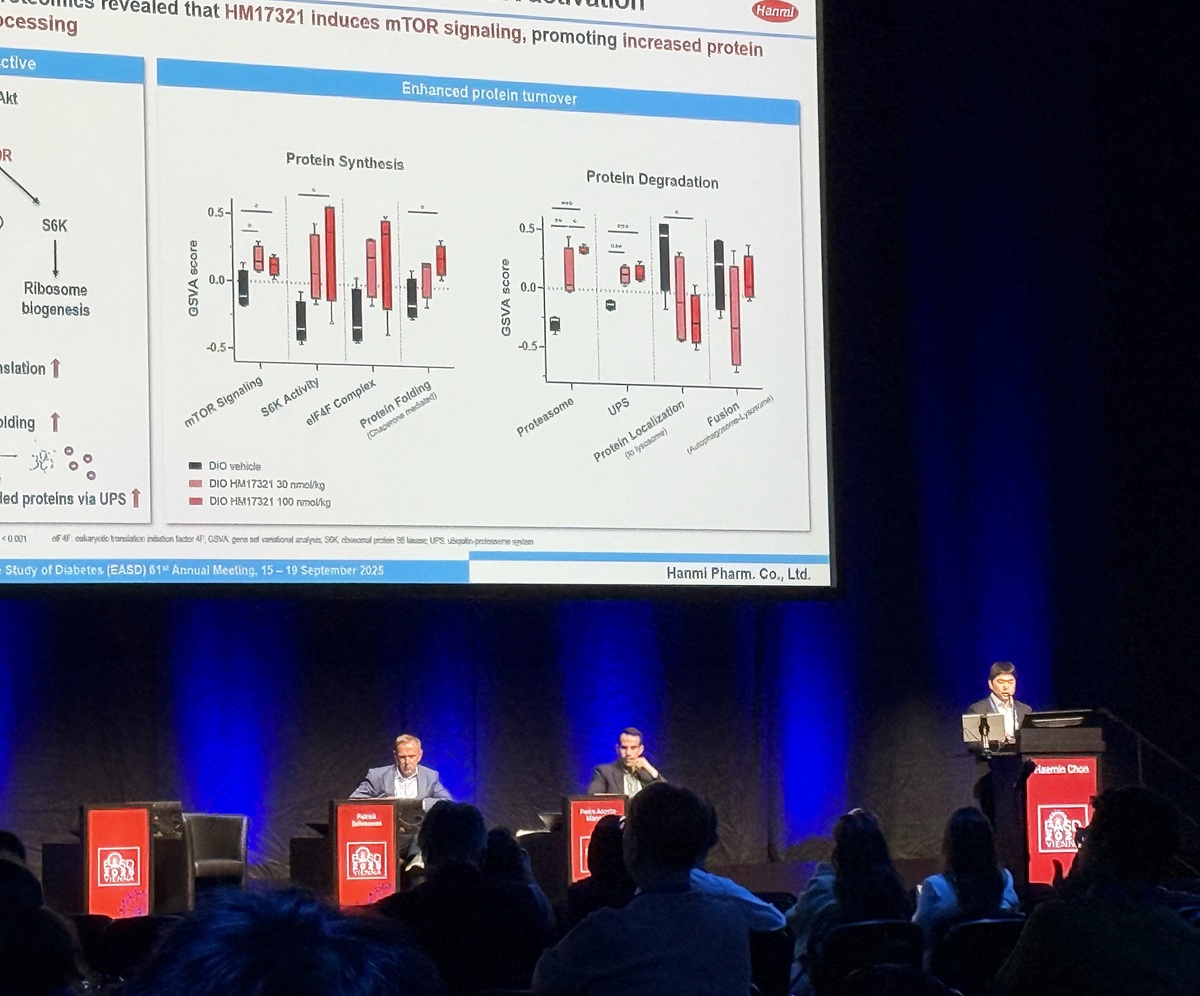
Haemin Chon, Vice President of Hanmi R&D Center, unveiled groundbreaking data on the muscle-enhancing
mechanism of HM17321, a novel obesity drug, at EASD 2025 in Vienna.
(Vienna, Austria, September 23, 2025) Hanmi Pharm has taken center stage on the global conference by unveiling previously unknown mechanism of muscle growth via CRFR2, a promising target for next-generation obesity management.
Unlike currently marketed GLP-1 based therapies, which inevitably accompany significant muscle loss, Hanmi’s innovative new drug HM17321 is raising expectations as a true “game changer” for its prominent fat-loss driven weight lowering effect with lean gain advantage.
At the 61st Annual Meeting of the European Association for the Study of Diabetes (EASD 2025), held September 15-19 in Vienna, Austria, Hanmi presented six preclinical studies across three pipelines. Key highlights included:
- * Proteomic analysis of skeletal muscle supporting muscle growth and metabolic improvement effects by HM17321 in diet induced obesity mouse model
* Efficacy of the novel UCN2 analogue HM17321 in weight loss without muscle wasting in obese non-human primates and its applications with incretins in obese mice
* A novel CRFR2 selective UCN2 analogue, HM17321, enhances favourable body recomposition, energy expenditure and metabolic health in DIO mice
* Circulating proteomics analysis reveals potential beneficial effects of HM17321 on muscle and bone
* Mechanistic insights into the potent anti-obesity effects of HM15275, a novel long-acting GLP-1/GIP/glucagon triple agonist
* HM101460, a potent and G protein-biased oral GLP-1R agonist with enhanced bioavailability, exhibits robust efficacy in animal models of type 2 diabetes and obesity
◆ HM17321: World’s First Obesity Therapy Proven to Possess Muscle Growth Mechanism
At this year’s congress, Haemin Chon, Head of Clinical Translational Research Team and Vice President at Hanmi R&D Center, delivered an oral presentation unveiling data from proteomic analysis of skeletal muscle in diet induced obesity mouse model treated with HM17321. The study elucidated the molecular mechanism underlying muscle growth and confirmed enhanced glucose utilization via metabolic adaptation.
HM17321 is being developed not merely as a anti-obesity therapy that mitigates muscle loss, but as the first-in-class metabolic innovation capable of simultaneous increase of lean mass and selective reduction of fat mass―a therapeutic outcome once considered unattainable.
Unlike incretin-based therapies such as GLP-1 agonists, HM17321 is a UCN2 (Urocortin-2) analog selectively targeting the CRFR2(corticotropin-releasing factor receptor 2), designed by Hanmi’s advanced AI-based structural modeling technologies named HARP (Hanmi AI-driven Research Platform).
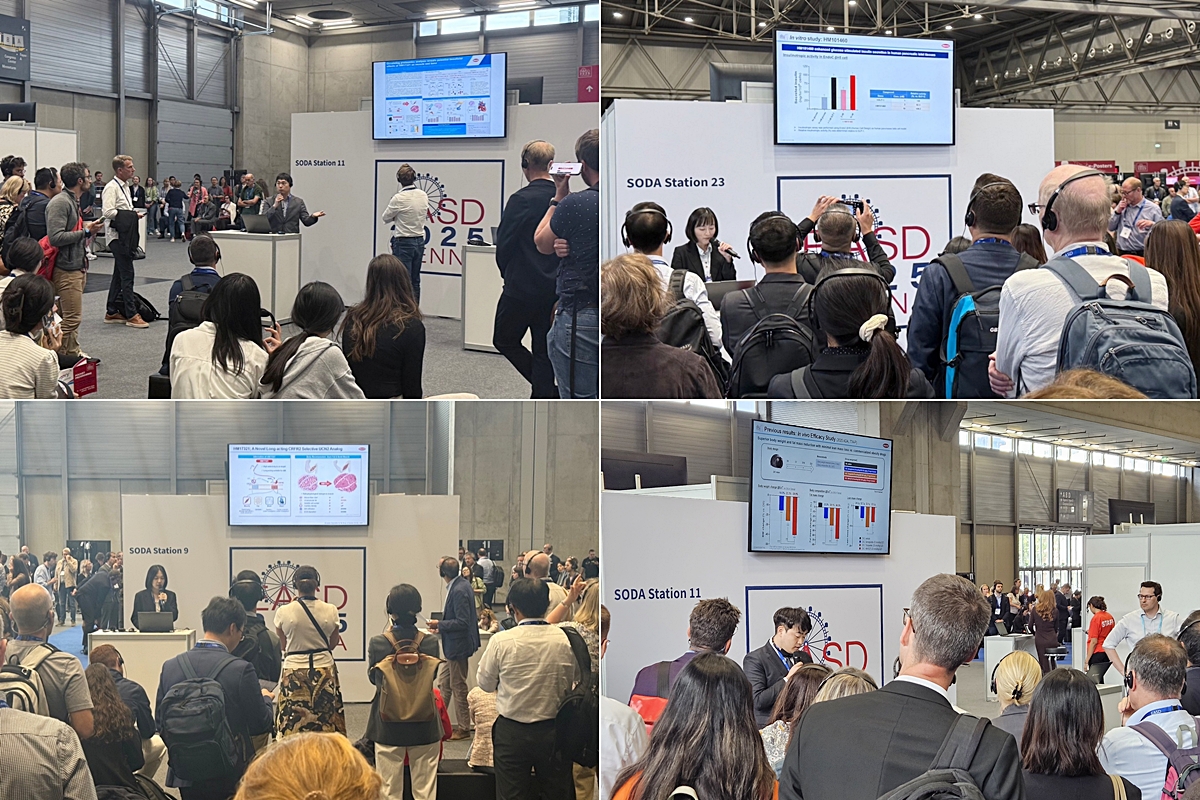
Hanmi Pharm R&D Center researchers at EASD 2025 (Vienna, Sept. 15, 2025)
presented highlight findings on HM15275, HM17321, and oral candidate HM101460.
From the oral presentation, Haemin exclaimed that HM17321 activates the mTOR (mammalian target of rapamycin) pathway, a classical pathway explaining muscle hypertrophy, and induces glycolysis-favoring metabolic adaptation. Further, proteomic analysis confirmed that HM17321 stimulates regulatory T cell-mediated activation of satellite cells, the precursors of muscle fibers, thereby promoting their proliferation and differentiation.
These findings suggest that HM17321 recapitulates the physiological mechanism of resistance exercise to promote muscle growth, capturing both functional improvement of muscle and minimal side effect risk.
A Hanmi official commented, “This mechanistic study elevated the clinical promise of HM17321 by addressing the long-standing challenge of reproducibility between animal and human studies―a critical barrier for first-in-class drug development.”
Additional long-term studies in obese primates (Rhesus monkeys) demonstrated selective fat mass reduction while preserving lean mass. Results from glucose tolerance testing (GTT) further indicated improved glycemic control, accompanied by reduced plasma triglyceride levels and favorable cardiovascular outcomes including blood pressure normalization.
A Hanmi official added:“The data presented at EASD provide meaningful validation that the pharmacologic efficacy of HM17321 is highly likely to be reproduced in humans as the program advances into Phase 1 clinical trial. With its unique potential to achieve ‘fat reduction, muscle growth, and functional & metabolic improvement,’ HM17321 is expected to emerge as a dominating therapy in the treatment of obesity as well as related metabolic disorders like sarcopenia.”
HM15275: Triple Agonist Demonstrates Superior Efficacy Over Retatrutide
Hanmi also highlighted new data on HM15275, a next-generation triple agonist positioned as a promising successor to “efpeglenatide”.
Leveraging Hanmi’s incretin expertise, HM15275 was meticulously engineered to achieve maximal weight reduction approaching that of bariatric surgery (≥25% body weight loss). In addition, by reducing lean mass loss through metabolic optimization, HM15275 is expected to deliver improved weight loss quality compared with other incretin analogues in market. These findings collectively support its potential to be developed as a best-in-class therapy in obesity area, with rapid development progressing toward commercialization by 2030.
At the congress, Hanmi presented evidence that the glucagon activity of HM15275 promotes browning of adipose tissue and directly contributes to enhanced energy metabolism in DIO (diet-induced obese) mice. In studies utilizing GLP-1 receptor knockout (KO)_DIO mice, HM15275 demonstrated markedly superior body weight loss compared with existing anti-obesity agents such as semaglutide (Wegovy®) and tirzepatide (Zepbound®, Mounjaro®) with improved glycemic control. These findings indicate that the triple-agonism of HM15275 has been precisely engineered to optimize efficacy for both obesity and diabetes treatment.
Furthermore, during long-term administration, HM15275 showed significantly greater amount of body weight loss than retatrutide, another triple-agonist, while distinctively reducing fat mass with comparable preservation of lean mass.
Hanmi also presented early-stage data for HM101460, its novel oral small-molecule GLP-1 receptor agonist. Preclinical findings confirmed that HM101460 exhibits G-protein-biased signaling, possibly promising more potent GLP-1 action with durable pharmacological activity. This represents Hanmi’s expertise in incretin research is again accelerating with accurate direction even in oral GLP-a field.
In Young Choi, Head of Hanmi R&D Center, stated: “Through our H.O.P. project, we are building a fully integrated obesity pipelines that set a new milestone for global healthcare. Hanmi will continue to lead innovation in this therapeutic area, driving solutions that combine efficacy, safety, and quality of life.”